Pages

Labels

Apple (26) Games News (5) Google (21) Health (2) high-tech (78) Microsoft (9) Other Sciences (3) Samsung (10) Science & Environment (5) Security (5) Technology (67) US & Canada (2)
Showing posts with label Microsoft. Show all posts

Wednesday, June 1, 2016

Microsoft opens up HoloLens platform to rivals, developers

635851990057458525-holo.JPG

SAN FRANCISCO — Augmented reality technology took one step closer to the mainstream Wednesday when Microsoft said it would open its Windows-based holographic platform to developers and rival device manufacturers.
"We built our HoloLens (headset) to push the limits of mixed reality," Terry Myerson, who runs Microsoft's Windows and Devices Group, told USA TODAY in an interview a few hours before unveiling the news at the Computextechnology trade show in Taipei. "Now we're looking to unlock opportunities for the ecosystem."
Virtual reality devices drop users into animated worlds while blocking out reality, whereas mixed — or augmented — reality tech overlays hologram-based images over the real world.
Microsoft listed a number of major companies that would begin factoring Windows Holographic into their plans, including HTC, Intel, Qualcomm, Acer, Dell, Hewlett-Packard and Lenovo.
By using Windows Holographic, the platform that powers HoloLens, content developers and hardware manufacturers will be able to create experiences that can be shared across devices, whether they are simple smartphone-based systems such as Google Cardboard or expensive PC-tethered headsets such as Oculus Rift.
Microsoft HoloLens is an all-in-one headset that stands apart from computer-tethered VR goggles from HTC and Oculus in that all of its technology is housed inside the wearable device, allowing users to walk around freely. The $3,000 device began shipping to developers this spring.
A few other companies are hard at work in the same AR goggle space, including Meta, Epson and ODG. In the near term, AR is seen as most useful in the enterprise space, allowing workers to collaborate together on hologram-rendered projects.
Microsoft CEO Satya Nadella is among those who believe that AR will represent the next generation of computing, ultimately eliminating the need for computer monitors and smartphones.
Currently, most virtual and augmented reality devices offer consumers experiences through different interfaces and peripherals. But the future of VR and AR is expected to be anchored to social interactions, which will require consumer gear to speak the same tech language.
Google recently made a similar gesture to help further popularize virtual reality, announcing at its recent developers conference a new platform called Google Daydream. But that initiative will be limited to improving the quality of Android smartphone VR experiences.
While HoloLens is among devices that is setting the standard for AR – which by 2020 should represent 75% of a projected $120 billion market, according to industry advisors Digi-Capital — augmented reality tech remains an expensive option for consumers.
By offering software and hardware developers access to Windows Holographic, some of those AR experiences can begin appearing on less expensive devices.
But the move also reflects how Nadella is hoping to make Windows the world's dominant operating system in a device-agnostic world.
Although the company lost ground with less than stellar Windows 8, 2015's Windows 10 is now running on 300 million active devices thanks in part to a free one-year upgrade program that ends July 29. Last year, Microsoft uncharacteristically appeared at an Apple company event in order to showcase how iPad Pro users could leverage Windows on the enterprise-focused tablet.
Nadella is two years into a major makeover of the storied Redmond, Wash., that has seen him scrap an ill-advised investment in Nokia's handset business and focus instead on building out the company's cloud-based enterprise subscription services as well as push into artificial intelligence and augmented reality.
video released by Microsoft Wednesday attempts to sketch out a vision of this future. It shows three colleagues creating a store interior while working in different places and using diverse devices all while sharing the same vision of the room. Their finished project is then presented to the client, who views the result in AR.

Friday, May 27, 2016

ACLU joins Microsoft suit against DOJ

635962340206173627-MSFT.JPG

SAN FRANCISCO — Microsoft got an ally in its lawsuit against the Justice Department Thursday.
The American Civil Liberties Union has filed a motion to join Microsoft's effort to challenge DOJ gag orders that prevent the tech company from telling customers when the government has ordered it to turn over data.
The ACLU is a Microsoft customer. Microsoft filed its lawsuit in April, one of a number of legal challenges the Redmond, Wash., company has mounted against growing law enforcement requests for its cloud-based consumer data.
“A basic promise of our Constitution is that the government must notify you at some point when it searches or seizes your private information,” said Alex Abdo, a senior staff attorney with the ACLU Speech, Privacy, and Technology Project. “Notice serves as a crucial check on executive power, and it has been a regular and constitutionally required feature of searches and seizures since the nation’s founding.”
Microsoft spokesperson David Cuddy said the company "appreciates the support from the ACLU and many others in the business, legal and policy communities who are concerned about secrecy becoming the norm rather than the exception.”
Requests from law enforcement agencies for access to users' personal information routinely flood tech companies that store vast amounts of data in the cloud. Massive data centers run by Microsoft, Amazon and other big tech companies allow businesses and individuals to access email, photos and other content from multiple devices, wherever they are.
Law enforcement officials say that access to such data is critical to fighting crime and terrorism.
Using the Electronic Communications Privacy Act, the U.S. government is increasingly targeting such data, according to Microsoft, which says the government has mandated secrecy in 2,576 instances over the past 18 months. People would know if the government went through their filing cabinet or their hard drive, but are unaware when their privacy in the cloud is intruded upon, they argue.
The 1986 law was written before the Web was born and long before Americans started sending, receiving and storing so much of their personal communications and documents on the Internet.
Microsoft alleges the Electronic Communications Privacy Act violates users' Fourth Amendment right that a search be reasonable and Microsoft's First Amendment right to talk to its users.
"Notably and even surprisingly, 1,752 of these secrecy orders, or 68% of the total, contained no fixed end date at all. This means that we effectively are prohibited forever from telling our customers that the government has obtained their data," Microsoft chief legal officer Brad Smith wrote in an April blog post when the suit was announced.
Tech companies increasingly are being drawn into legal battles with federal agencies over access to consumer information. A broad swath of major technology names filed amicus briefs on behalf of Apple during the iPhone maker's protracted battle with the FBI earlier this year over access to the smartphone used by one of the San Bernardino killers.

Thursday, May 26, 2016

Microsoft, Facebook to lay massive undersea cable


MAREA_Cable
SAN FRANCISCO — A 4,000 mile undersea cable deal announced Thursday by Microsoft and Facebook is just the latest of a dozen high capacity trans-oceanic cables being built by tech companies to deal with their insatiable demand for bandwidth.
The two companies plan to build a cable that will run from Virginia Beach, Va. to a data hub in Bilbao, Spain.
The cable will join a cat's cradle of cables that criss-cross the ocean floor, an increasing number of which are owned or funded by large tech companies.
Google began the trend in 2010 when it invested in a cable across the Pacific between the United States and Japan called Unity.
Today, Google either has or plans to invest in five undersea cables, Microsoft four, Facebook two and Amazon one, said Alan Mauldin, research director with telecommunications research firm TeleGeography.
And those are only the public deals. “There are others that aren’t public,” he said.
Currently, two-thirds of all traffic on undersea Atlantic cables is from private networks and not telecommunications companies, up from 20% in 2010, according to TeleGeography data.
Driven by data demands
In the past five years, demand for bandwidth has shifted from traditional telecom companies to large content providers. Their need for bandwidth is growing so rapidly that it makes economic sense for them to invest in their own infrastructure, said Gartner analyst David Smith.
“Rather than pay a telco, they’re going to build their own,” he said.
The Microsoft/Facebook cable will be called "Marea," which means "tide" in Spanish. The companies are collaborating in order to accelerate the development of the next-generation of Internet infrastructure and support the explosion of data consumption and rapid growth of each company’s respective cloud and online services, Microsoft said in a statement to USA TODAY.
While the cable's actual width is about the size of an ordinary garden hose, its capacity is "massive," able to transmit 160 terabytes per second, said Mauldin.
Currently there are about 337 terabytes of potential capacity across the Atlantic. When the Marea cable comes online in 2017 with 140 terabytes per second of capacity, “this one cable will be able to do almost half of what all the cables do,” he said.
Marea will be operated and managed by Telxius, a telecommunications infrastructure company  owned by Telefónica, a large, Spanish telecommunications company with a significant presence in Europe and Latin America.
The cable will also provide redundancy for companies increasingly dependent on information being instantly transmittable worldwide. Marea will be the first southern European cable route.
No one wants to have their capacity dependent on just one cable, "because if it breaks, you’re in trouble,” said Mauldin.
Being physically separate from these other cables helps ensure more resilient and reliable connections for both companies' customers in the United States, Europe, and beyond, Microsoft said in a statement.
While many still imagine that traffic between the continents runs via satellites, they’re neither fast nor good enough. “There a huge delay with satellites,” said Smith.
Cables are almost instantaneous, more robust and cheaper. As tech companies increasingly become international, "the cloud is under the ocean," he said.
The cable will help the companies meet growing customer demand for high speed, reliable connections for cloud and online services, Microsoft said in a post on its website.
Microsoft said it needed the increased bandwidth to it could provide high speed, reliable connections for customers using Microsoft cloud services, which include its search engine Bing, Office 365, Skype, Xbox Live, and Microsoft’s cloud computing platform Azure.
MAREA will be the highest-capacity subsea cable yet laid across the Atlantic, It will feature eight fiber pairs and have an initial estimated capacity of 160Tbps.

Wednesday, May 25, 2016

Microsoft to cut up to 1,850 jobs

635962340206173627-MSFT.JPG

Microsoft (MSFT) announced Wednesday it will cut up to 1,850 jobs as part of a plan to streamline its smartphone hardware business.
The company says it will record an impairment and restructuring charge of about $950 million because of the cuts tied to its failed acquisition of Nokia's handset business in 2014.
"We are focusing our phone efforts where we have differentiation — with enterprises that value security, manageability and our Continuum capability, and consumers who value the same,” said Microsoft CEO Satya Nadella in a statement. “We will continue to innovate across devices and on our cloud services across all mobile platforms.”
The cuts will be complete by July 2017.
Last week, Microsoft confirmed it is selling its feature phone business to Finnish company HMD and Foxconn subsidiary FIH Mobile for $350 million. The company said it would continue to support Windows 10 Mobile and any Lumia smartphones running the operating system. The deal also marked Nokia's return to the mobile phone business.
Microsoft announced the $7 billion acquisition of Nokia's handset business in 2013, and it turned into a disaster for the tech giant. Last year, after revealing massive job cuts affecting 18,000 employees, Microsoft announced it would slash another 7,800 jobs in connection to its Nokia deal.

Tuesday, May 24, 2016

Microsoft accused of Windows 10 upgrade 'nasty trick'

Microsoft box

Microsoft has faced criticism for changing the pop-up box encouraging Windows users to upgrade to Windows 10.
Clicking the red cross on the right hand corner of the pop-up box now activates the upgrade instead of closing the box.
And this has caused confusion as typically clicking a red cross closes a pop-up notification
The upgrade could still be cancelled, when the scheduled time for it to begin appeared, Microsoft said
The change occurred because the update is now labelled "recommended" and many people have their PCs configured to accept recommended updates for security reasons.
This means dismissing the box does not dismiss the update.
Brad Chacos, senior editor at the PC World website, described it as a "nasty trick".
"Deploying these dirty tricks only frustrates long-time Windows users who have very valid reasons to stick with operating systems they already know and love," he wrote.
Microsoft said: "With the free Windows 10 upgrade offer ending on 29 July, we want to help people upgrade to the best version of Windows.
"As we shared in October, Windows 10 will be offered as a 'recommended' update for Windows 7 and 8.1 customers whose Windows Update settings are configured to accept 'recommended' updates.
"Customers can choose to accept or decline the Windows 10 upgrade."

Friday, May 20, 2016

Microsoft brings Skype to businesses’ iOS and Android apps


Microsoft is further opening up Skype to businesses. On Thursday, the company launchedits Skype for Business SDK – tools which allow iOS and Android developers to integrate Skype’s messaging, audio and voice capabilities into their own mobile applications. The idea is to allow Skype to power the communications experience inside applications, so developers can focus on building their product’s unique features.
This is an area other messaging-focused startups also tackle to some extent, including former TechCrunch Disrupt winner Layer and, more recently, chat tools provider Sendbird, for example. Microsoft’s solution, however, is aimed at larger enterprises.
Skype for Business SDK customers can continue to use their existing infrastructure, like Skype for Business Server or Skype for Business Online – depending on if the company has deployed Unified Communications on their own servers, or if they’re relying on Microsoft’s cloud. In addition, companies adopting the Skype for Business SDK can continue to use their existing native clients to reach their customers,
However, during this SDK preview period, the focus for the integrations is on “remote advisor” functionality. That is, businesses who want to interact with remote customers over their mobile phones and tablets in order to chat, call or video chat.
mdlive
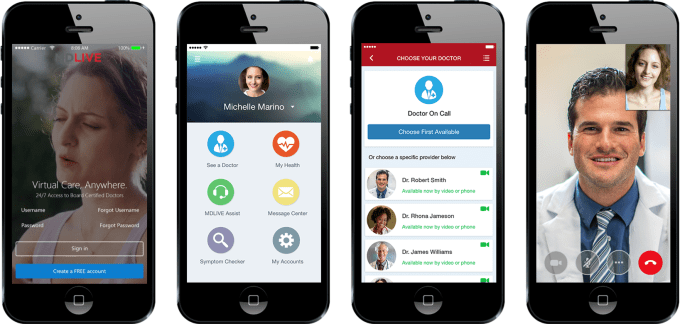
You may remember an example of this functionality was demoed earlier this year at Microsoft’s Build 2016 conference, when the company showed off a telehealth app created by MDLIVE. In the app, doctors offered patients virtual care via video calling sessions. They can also share and review medical records, lab results, send messages, and more. Patients, meanwhile, can book, schedule then connect with doctors for real-time chats right in the application at their appointment time.
Healthcare isn’t the only scenario where a “remote advisor” makes sense, of course. The platform could also be used by financial advisors, customer service, and a variety of other enterprise applications.
Microsoft says that if the company is licensed for Skype for Business Server or Skype for Business Online, then there are no additional costs for the use of the SDKs.

Microsoft CEO Satya Nadella to Visit India This Month

Microsoft CEO Satya Nadella to Visit India This Month


Close on the heels of Apple chief Tim Cook's visit to India, Microsoft CEO Satya Nadella will be in India later this month.
In his third visit to the country in just seven months, Hyderabad-born Nadella is expected to meet entrepreneurs and developers as part of the trip.
Microsoft will also host an event with Nadella on May 30. According to invites, the head of the US-based software giant will talk about "how technology is fostering a culture of innovation to solve real-world problems and driving India's transformation".
Nadella was in India last December. He had met Andhra Pradesh Chief Minister N Chandrababu Naidu and visited the campus of startup incubator T-hub and Microsoft development centre in Hyderabad.
In November, he had delivered a keynote address at Microsoft's 'Future Unleashed' event in Mumbai and met industry leaders like Mahindra Group chairman Anand Mahindra and Axis Bank managing director Shikha Sharma.
These visits and increasing engagements by global leaders highlight India's rise as a huge technology consumer and not just as an outsourcing destination.

Tuesday, May 17, 2016

Microsoft's Windows 10 upgrades are getting even more sneaky-pushy


Microsoft has a new way of trying to get Windows 10 onto your computer, whether you want it or not.
Users of Windows 7 and 8.1 have become familiar with -- jaded by, even -- the insistent, seemingly daily popups urging them to "GetWindows 10." Those messages have started taking a more aggressive turn.
Instead of simply giving you the option to install its latest operating system (or not), Microsoft now automatically schedules a date and time to update your PC to Windows 10. If you don't want the software update or if you want to change the installation date, you have to take deliberate action: manually click a link in the message, then choose to reschedule it or cancel it altogether.
Kinda sneaky, isn't it? Especially compared with the messages you've been seeing. If you click the OK button, thinking you're just getting rid of the message, the automatic update is scheduled. You'll then find Windows 10 on your PC sometime over the next several days without realizing that you agreed to it.
"We updated Windows 10 to a 'Recommended' update for Windows 7 & 8.1 customers whose Windows settings are configured to accept 'Recommended' updates on Thursday, May 12, 2016," a Microsoft spokeswoman said. "We added the additional notification based on user feedback and to ensure customers had an opportunity to change or cancel the schedule for the upgrade to Windows 10."
Following the debacle of the little-loved Windows 8, Microsoft has been working hard to convince people to jump to Windows 10, which is available for free to users of Windows 7 or 8.1. That freebie, though, is due to end July 29, the one-year anniversary of version 10's debut. After that date, people will have to pay to upgrade. In other words, they'll have even less incentive.
The latest version of Windows has been making inroads. Earlier this month, Microsoft announced that Windows 10 had found a home on 300 million active devices, a tally that includes PCs, phones and the Xbox One game console. That's nearly a third of the way to the software giant's goal of reaching 1 billion Windows 10 devices within two to three years of the software's release.


Likewise, Windows 10 leapfrogged both Windows 8.1 and the aging, enduring Windows XP earlier this year to become the second most widely used version of the softwarethat once defined personal computing for many. Windows 7 remains top dog, accounting for nearly 50 percent of desktops running versions of the operating system.
After July 29, upgrading to the Home version of Windows 10 will cost $119, while the Pro flavor will be priced at $199. Oh, and sneaking in there sometime this summer, possibly in July, will be another freebie offer: the Windows 10 Anniversary edition, sporting enhancements to the Cortana personal assistant and the Hello login feature, along with support for the HoloLens augmented-reality headset.


Microsoft to recycle 1 million dormant Xbox Live Gamertags


Have you always wanted a cool username on Xbox Live but were late to the party?
You're in luck. On Wednesday, the online ecosystem will make available nearly 1 million Gamertags linked to abandoned accounts from the original Xbox era, said Larry "Major Nelson" Hryb, the company's Xbox Live programming director.
"These accounts never migrated to Xbox 360 and as a result they have been inactive for quite some time," Hryb wrote in a blog post.
Hryb said he couldn't share the list of Gamertags that will be made available but did say that the usernames fall in a variety of categories, including proper names, pop culture references, and food, among others.
The tags will be released at 11 a.m. PT at Xbox.com, the Xbox app on Windows 10 and on the Xbox Oneconsole. To participate in the 24-hour-long name-grab, subscribers must be Xbox Live Gold members with a cumulative Gold tenure of at least one year.