Pages

Labels

Apple (26) Games News (5) Google (21) Health (2) high-tech (78) Microsoft (9) Other Sciences (3) Samsung (10) Science & Environment (5) Security (5) Technology (67) US & Canada (2)
Showing posts with label Other Sciences. Show all posts

Wednesday, May 18, 2016

Nasa's New Horizons Spots Kuiper Belt Object


Nasa's New Horizons Spots Kuiper Belt Object


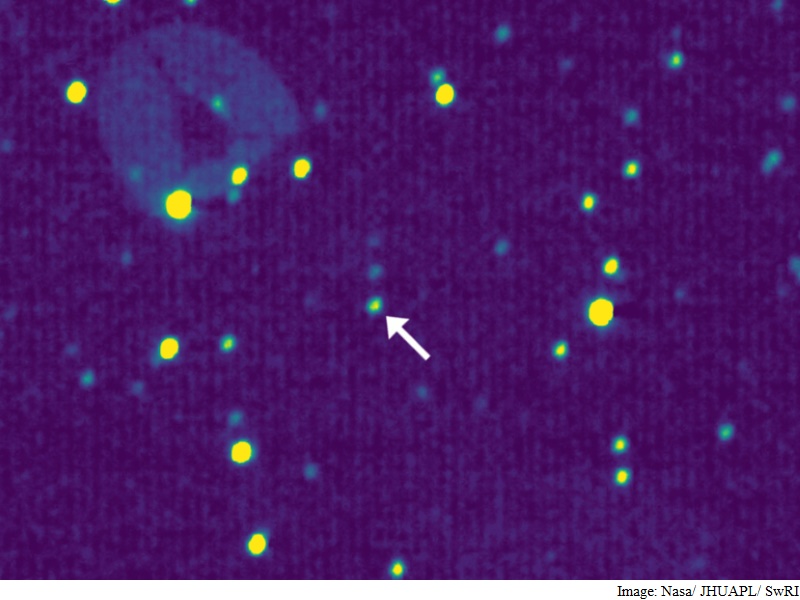
After making a historic Pluto flyby last July and now in deep space, Nasa's New Horizons spacecraft has twice observed a first object in Kuiper Belt - a region of the solar system beyond the orbit of Neptune.
"1994 JR1" is a 145-km-wide Kuiper Belt object (KBO) orbiting more than 5 billion km from the Sun.
Taken from the spacecraft's Long Range Reconnaissance Imager (LORRI) in April, the images shatter New Horizons' own record for the closest-ever views of this KBO in November 2015 when New Horizons detected "JR1" from 280 million km away.
The observations contain several valuable findings.
"Combining the November 2015 and April 2016 observations allows us to pinpoint the location of JR1 to within 1,000 km, far better than any small KBO," said Simon Porter from Southwest Research Institute (SwRI) in Boulder, Colorado.
The more accurate orbit also allows the science team to dispel a theory, suggested several years ago, that JR1 is a quasi-satellite of Pluto.
The team also determined the object's rotation period, observing the changes in light reflected from JR1's surface to determine that it rotates once every 5.4 hours (or a JR1 day).
"That's relatively fast for a KBO. This is all part of the excitement of exploring new places and seeing things never seen before," added science team member John Spencer from SwRI in a Nasa statement.
The observations are great practice for possible close-up looks at about 20 more ancient Kuiper Belt objects that may come in the next few years.
New Horizons flew through the Pluto system on July 14, making the first close-up observations of Pluto and its family of five moons.
The spacecraft is on course for an ultra-close flyby of another Kuiper Belt object, "2014 MU69", on January 1, 2019.

Tuesday, May 17, 2016

Sediments in Gulf of Naples reveal impact on Roman water distribution after Vesuvius eruption


(Phys.org)—A team of researchers with members from France, the U.S., the U.K. and Italy has found evidence of disruptions to the water delivery system in the area around Naples after the eruption of Mount Vesuvius in AD 79. In their paper published in Proceedings of the National Academy of Sciences, the team describes their testing of sediment cores taken from the harbor at Naples, what they found and what their study has revealed about the history of the area.
To bring water to cities, the early Romans built vast waterworks systems using aqueducts and lead pipes—the water that was delivered, unbeknownst to the Romans, contained some amount of lead which in addition to making its way into the bodies of those who drank it, also made it into the ground or other water systems via sewage. In the case of the cities and towns around Naples, sewage was piped to certain locations where it was dumped directly into the harbor which resulted in sediment build up, some of which contained lead particles. Modern researches studying sediment cores can analyze the different layers of sediment and note the different amounts of lead in it and the differences in the types of lead, which can offer information about the amount of water brought into the system, and in this case, the changes to the system that came about.
In studying their sediment core samples taken from the harbor, the researchers found marked changes in lead particles immediately after Mount Vesuvius erupted, likely, they suggest, because the eruption either clogged pipes, or destroyed some of the water delivery system. Differences in isotopic composition, they noted suggested lead pipes had been brought in from different locations to replace those that had been damaged. They noted also that the original water system had remained in place for approximately 15 years after the eruption before it was finally replaced. The team also found evidence of a continually expanding water system until approximately the fifth century, when natural disasters and invasions led to a sharp decline in upgrades.
The researchers suggest their techniques could be used in other parts of the world, not just the area once covered by the Roman Empire—to better understand population changes, or other events that had an impact on the people that lived there.
 Explore further: Lead in 'tap-water' in ancient Rome up to 100 times more than local spring waters
More information: Hugo Delile et al. A lead isotope perspective on urban development in ancient Naples, Proceedings of the National Academy of Sciences (2016)
Abstract
The influence of a sophisticated water distribution system on urban development in Roman times is tested against the impact of Vesuvius volcanic activity, in particular the great eruption of AD 79, on all of the ancient cities of the Bay of Naples (Neapolis). Written accounts on urbanization outside of Rome are scarce and the archaeological record sketchy, especially during the tumultuous fifth and sixth centuries AD when Neapolis became the dominant city in the region. Here we show that isotopic ratios of lead measured on a well-dated sedimentary sequence from Neapolis' harbor covering the first six centuries CE have recorded how the AD 79 eruption was followed by a complete overhaul of Neapolis' water supply network. The Pb isotopic signatures of the sediments further reveal that the previously steady growth of Neapolis' water distribution system ceased during the collapse of the fifth century AD, although vital repairs to this critical infrastructure were still carried out in the aftermath of invasions and volcanic eruptions.


Research finds skull condition thought extinct is actually widespread


Some forensic anthropologists thought the skull condition called cribra orbitalia (CO) was a thing of the past – but new research from North Carolina State University and the University of the Witwatersrand finds that it not only still exists, but is fairly common in both North America and South Africa.

CO is a condition in which the bone inside the eye sockets becomes porous. It is not known to cause any , but is generally regarded as being caused by .
The condition has traditionally been used by anthropologists to assess diet and health in prehistoric populations. For example, the presence of CO could tell researchers that a population was not getting a sufficiently varied diet.
"But there's been a lot of debate about the prevalence of CO in modern populations, with some saying it had effectively disappeared," says Ann Ross, director of the Forensic Sciences Institute at NC State and co-author of a paper on the work. "We wanted to know if CO was still extant and, if so, how common it is in modern populations, relative to earlier eras."
For this study, the researchers looked at modern, historic and prehistoric human remains from South Africa, North Carolina and the Western Hemisphere Database. Altogether, the researchers evaluated data on 844 : 245 prehistoric, 381 historic (as recent as the early 20th century) and 218 modern.
Their findings were surprising.
The researchers found that CO was not only present in modern populations, but that it was not even uncommon.
For example, the researchers found that two of the five modern North American juvenile skulls evaluated in the study – 40 percent – had CO. And 15 of the 60 South African juveniles evaluated in the study – 25 percent – had CO.
"We thought we might see some CO, but not to the extent that we did," Ross says. "The high rates may stem from the fact that these remains were part of forensic cases – there were often related to cases of homicide or neglect. These cases are not representative of health for all children."
Overall, the researchers found that 12.35 percent of modern North Americans and 16.8 percent of modern South Africans, across all age groups, had CO.
Both rates are higher than their historic counterparts. Only 2.23 percent of historic South African skulls evaluated had CO, and only 6.25 percent of historic North American skulls. Even the prehistoric North American skulls had a lower rate of CO, at 11.86 percent.
"We think the increased prevalence of CO in the modern skulls may be due to intestinal parasites in some populations and iron-poor diet," Ross says.
"These findings drive home the fact that disadvantaged socioeconomic groups, and parts of the developing world, are still struggling with access to adequate nutrition," Ross adds. "Corn may give people a full belly, but it's not going to give people all of the nutrients they need to be healthy."